| |
STORIES, BOOKS & MEDIA

The majority of the following books are from the library of Chon Tri. Many of the summaries and in his own words. If you wish to purchase the book, click on the cover image and you will be linked to Amazon.com.
| Select a Category » |
[
Foundation
]
[
Practice
]
[
Sutra & Sastra
]
[
Koans
]
[
Works
]
[
History & References
]
[
Essays & Studies
]
[
Others
]
» Buy this book
» Recommend a Book
|
|
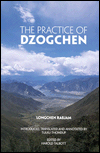
41. THE PRACTICE OF DZOGCHEN
by Longchen Rabjam, Tulku Thondup (translator)
Publisher: Snow Lion Publications, Incorporated (ISBN #: 1559390549, Hardcover, 488 pp, March 1995)
» Submit a review
Summary
From the Publisher
The Practice of Dzogchen is an anthology of writings on Dzogpa Chenpo (Dzogchen) by Longchen Rabjam (1308-1363) the most celebrated writer and adept of the Nyingmapa School of Tibetan Buddhism. Dzogpa Chenpo is the innermost esoteric philosophy and meditation training, which until recent decades was only whispered into the ears of heart-disciples by the learned masters. Dzogpa Chenpo employs a meditative technique which effortlessly uncovers the emotional and intellectual layers of the mind and instantly awakens its essential nature, which is Buddha Mind or Buddhahood itself.
|

|
42. THE TIBETAN BOOK OF THE DEAD
by Padma-Sambhava, Lama Kazi Dawa-Samdup (translator),Walter Y. Evans-Wentz (editor)
Publisher: Oxford University Press (ISBN #: 0195002237, Paperback, 249 pp, May 1976)
» Submit a review
Summary
Annotation
This remains one of the most unique sacred books of the world because it contributes to the science of death, existence after death, and rebirth.
Customer Reviews:
Hospice Counselor, A reviewer, May 24, 2000
A Sacred Text
This book is a blueprint on the nature of soul. It guides you into levels of consciousness that engages optimum freedom for the soul at the moment of death and beyond. It is a book that should be on the self of anyone who works with the dying.
|
|
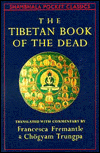
43. THE TIBETAN BOOK OF THE DEAD: THE GREAT LIBERATION THROUGH HEARING IN THE BARDO
by Padma-Sambhava, Francesca Fremantle (translator) & Chogyam Trungpa
Publisher: Shambhala Publications, Inc. (ISBN #: 0877736758, Paperback, Pocketsize, 288 pp, July 1994)
» Submit a review
Summary
Ingram
In this classic scripture of Tibetan Buddhism--traditionally read aloud to the dying--death and rebirth are seen as a process that offers the possibility of attaining ultimate liberation. This translation emphasizes the practical advice that the book offers to the living, with many lessons in human psychology. Two-color interior.
Book Description
Shows that these ancient teachings are penetrating and relevant, not only for understanding death, but as a guide to life. Illustrated.
|
|
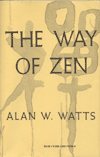
44. THE WAY OF ZEN
by Alan Watts
Publisher: Vintage Books (ISBN #: 394702980, Paper back, 236 pages, August 1989)
» Submit a review
Summary
From the Inside Flap
The Way of Zen begins as a succinct guide through the histories of Buddhism and Taoism leading up to the development of Zen Buddhism, which drew deeply from both traditions. It then goes on to paint a broad but insightful picture of Zen as it was and is practiced, both as a religion and as an element of diverse East Asian arts and disciplines. Watts's narrative clears away the mystery while enhancing the mystique of Zen.
|
|
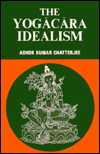
45. THE YOGACARA IDEALISM
by Ashok Kumar Chatterjee
Publisher: Motilal Banarsidass Publisher (ISBN #: 8120803159, Hardcover, 237 pp, January 1987)
» Submit a review
Summary
Book Description
Expounds the metaphysics of the Yogacara school of Buddhism in all its aspects and bearings. Chapters are devoted to a critical and constructive discussion of its idealistic core as well as its spiritual discipline. This book was acclaimed as a unique contribution to the study of Buddhism on its first publication in 1962 and subsequently in 1975. This reprint after a lapse of more than ten years fills the need for the new generation of students and researchers.
|
|
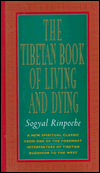
46. TIBETAN BOOK OF LIVING AND DYING
by Sogyal Rinpoche, Patrick Gaffney (Editor), Andrew Harvey (Editor)
Publisher: Harper Collins Publishers (ISBN #: 0062507931, Hardcover, 425 pp, August 1992)
» Submit a review
Summary
From the Publisher
In this major and comprehensive work, Buddhist meditation master and international speaker Sogyal Rinpoche brings together the ancient wisdom of Tibet with modern research on death and dying and the nature of the universe. With unprecedented scope, The Tibetan Book of Living and Dying clarifies the majestic vision of life and death that underlies The Tibetan Book of the Dead. Sogyal Rinpoche presents simple yet powerful practices from the heart of the Tibetan tradition that anyone, whatever their religion or background, can do to transform their lives, prepare for death and help the dying. He gives advice on how to care for the dying with love and compassion and offer them spiritual assistance. Rinpoche presents his own vision of the near-death experience from the Tibetan perspective. He explains in detail the "bardos," those states of consciousness after death that have fascinated and tantalized Western artists, psychologists, scientists, doctors, and philosophers ever since the publication of The Tibetan Book of the Dead in 1927. The Tibetan Book of Living and Dying is not only a spiritual masterpiece but also a manual, a guide, a work of reference, and a source of sacred inspiration.
|
|
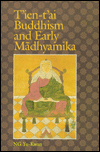
47. T'IEN-T'AI BUDDHISM AND EARLY MADHYAMIKA
by NG Yu-Kwan
Publisher: University of Hawaii Press, The (ISBN #: 0824815602, Hardcover, 280 pp, March 1995)
» Submit a review
Summary
"This is a pivotal work on a pivotal period in Chinese Buddhism. It exhibits rare insights into the inner workings of the great T'ien-tai master Chi-i, who greatly changed the course of Far Eastern Buddhism with his unique interpretation of key Mahyamika doctrines. The analisys of Chi-i's principal works is precise, incisive and brilliant. The work sets a high standard on probing Buddhist hermeneutics as well as for future depth studies in Chinese Buddhism."
- Kenneth K. Inada, State University of New York at Buffalo.
|
|
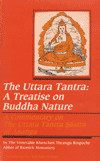
48. UTTARA TANTRA: A TREATISE ON BUDDHA NATURE
by Rinpoche Khenchen Thrangu; Ken & Katia Holmes (translators)
Publisher: Sri Satguru Publications (ISBN #: 8170304016, Hard cover, 200 pp, January 1995)
» Submit a review
Summary
Commentary on Buddhist canonical text ascribed to Asaçnga
|
|
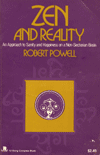
49. ZEN AND REALITY: AN APPROACH TO SANITY AND HAPPINESS ON A NONSECTARIAN BASIS
by Robert Powell
Publisher: Viking Penguin (ISBN #: 0140045325, Paperback, 142 pp, July 1977)
» Submit a review
Summary
"The author elucidates in the course of his inquiry that Zen, shown of its institutionalized practices, is essentially a pointer to an insight into the simple truth of living - a path, yet not of time, that is basically the same as the direct approach which has been so clearly indicated by J. Krishnamurti. "Zen Buddhism can be described as a school seeking to find the 'self', rather than in ceremony or doctrine, the path to wisdom, and has its inner message; the less done, the clearer is reality; the less said, the more direct our apprehension." (From the back cover of the book).
|
|
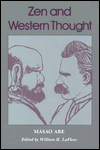
50. ZEN AND WESTERN THOUGHT
by Masao Abe
Publisher: 082481214X (ISBN #: 082481214X, Paperback, 208 pp, December 1990)
» Submit a review
Summary
From The Critics
Three quarters of this collection of articles by an outstanding philosopher of the Kyoto school is devoted to elucidating Zen for the West. The level of treatment presupposes some experience in Zen meditation as well as a solid background in philosophy and religion. Readers possessing these will find Abe's expositions of Mu , nirvana, purity, Emptiness, Buddha-Nature in Dogen as well as comparisons with Nietzsche, Whitehead, Tillich, Christianity, and science very valuable. The final section, which urges the necessity of transcending nationalism in order to realize a true world community bound together in egoless compassion, is especially timely as well as accessible to educated nonspecialists. Highly recommended. Astrid M. O'Brien, Humanities Div., Fordham Univ., Coll. at Lincoln Ctr., New York . Library Journal.
|
|
|

SUPPORT ZENGUIDE.COM
Purchase posters, art prints, media (music CD & DVD)
 ZEN GARDEN 2
by Anonymous
→Puchase this Item
→More Art Prints & Media
→Zen & Buddhism books
|
|
|
s
.
t
.
o
.
r
.
i
.
e
.
s
.
,
.
.
b
.
o
.
o
.
k
.
s
.
.
&
.
.
m
.
e
.
d
.
i
.
a
.
|